The response to the Covid-19 pandemic in 2020 showed that it is possible to make tough political decisions in the face of an urgent threat. When it comes to climate change, however, despite indisputable evidence that anthropogenic climate change is causing increasing harm, political leaders appear incapable of mobilising the necessary action to reduce greenhouse gas emissions. Climate science is crystal clear: to avoid the worst effects of climate change, global greenhouse gas emissions must fall by at least 43% of 2019 levels by 2030. But despite increasingly desperate exhortations to act, emissions continue to rise.
One of the key reasons for this failure to act is corporate interference in policymaking and implementation, aimed at weakening and delaying regulatory action to tackle climate change – otherwise known as negative corporate climate lobbying. In many instances, this manifests itself in high-level public positions of support for the Paris goals, but “closed-door undermining of climate action”.
Corporate anti-climate lobbying (also referred to simply as “climate lobbying”) has been on the rise since the signing of the Kyoto Protocol in 1997, ramping up significantly after the adoption of the Paris Agreement in 2015. Unsurprisingly, the fossil fuel industry is the biggest impediment to Paris-aligned climate policy. Corporate lobbying affects the adoption, stringency, and implementation of climate action, leaving climate policies around the world weak and deficient, at enormous cost to society.
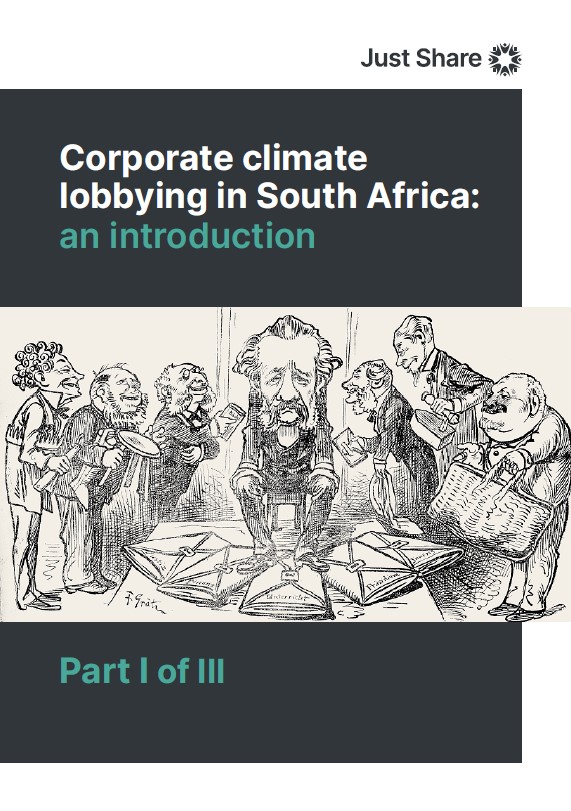
This brief is the first in Just Share’s series of three corporate lobbying briefs. Part I sets out the fundamentals of corporate climate lobbying: what it means, how it works in practice and the impact it has had, and continues to have, on global climate action. It looks at the global history of corporate lobbying against climate action before exploring the key tactics and strategies employed by climate lobbies around the world, including in South Africa. Finally, it introduces the question of who the corporate lobbyists are in South Africa, and the role of regulation in addressing corporate lobbying, which will be explored in detail in Parts II and III respectively.
Part I: Corporate lobbying in South Africa: an introduction
• Introduction to corporate climate lobbying and its effect on global climate action.
• Breaking down the elements of corporate climate lobbying.
• How corporate climate lobbying works, and its history.
• Regulating corporate lobbying.
• Introduction to Part II.
Part II: Lobbying in South Africa
• Who are the lobbyists? Including companies, industry associations, public relations firms and
advertising agencies.
• Lobbying by NGOs, think tanks, grassroots organisations, and industry bodies.
• Case study of direct lobbying: South African government’s climate change response.
• Case study of indirect lobbying: Establishing a narrative that pits the low carbon transition
against development and poverty alleviation.
Part III: Lobbying regulation frameworks: law and other measures
• Lobbying is unregulated in South Africa.
• International regulatory regimes governing lobbying.
• Barriers to regulation.
• How investors and NGOs are stepping up in the absence of effective regulation:
» Frameworks
» Assessments
» Shareholder resolutions
» Litigation