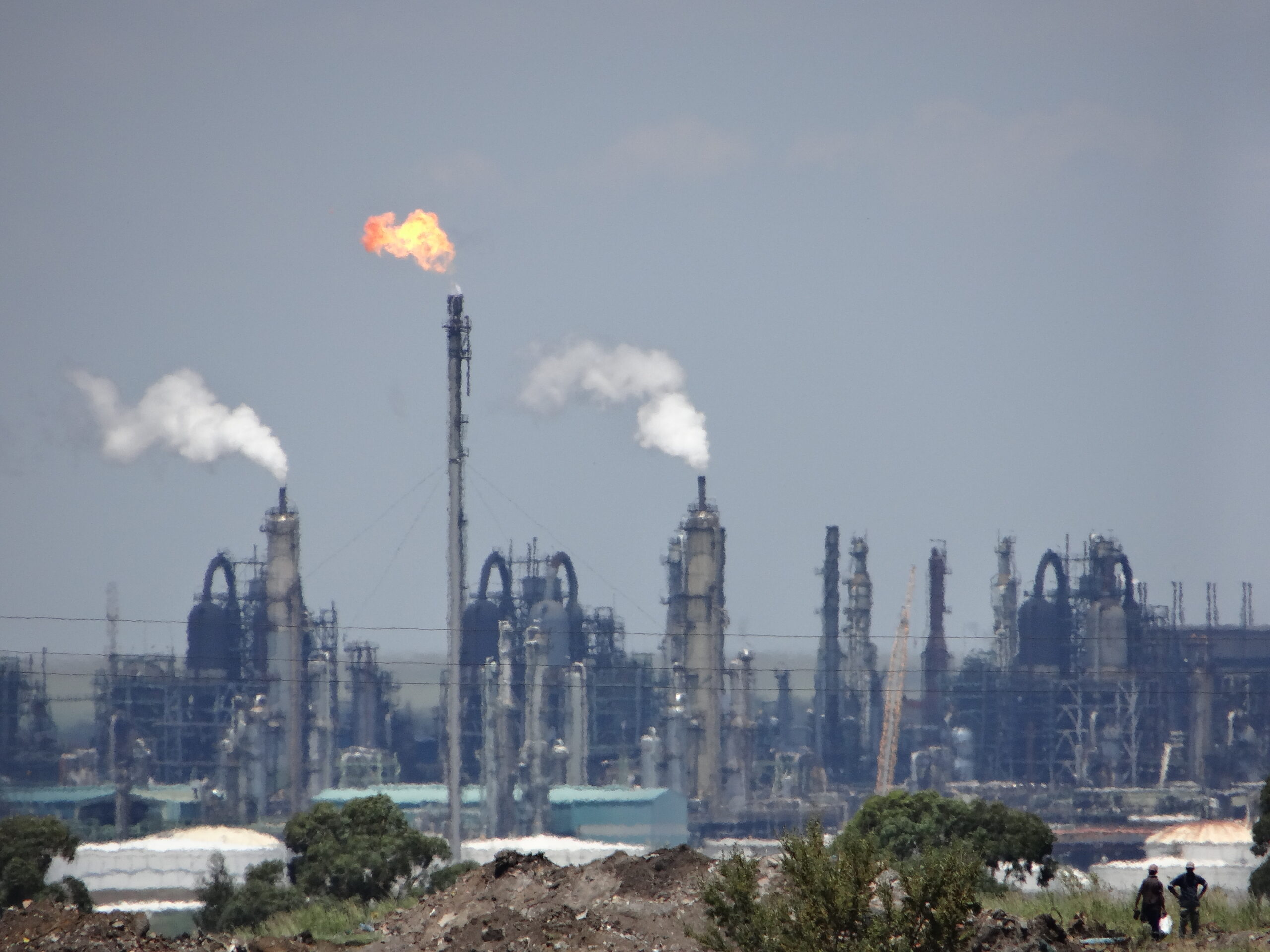
Just Share’s latest investor briefing, Driving a credible and just transition at Sasol, examines the company’s climate transition strategy, environmental performance and progress towards its stated goals. As expected, Sasol’s emissions increased this year and will continue to increase as it ramps up production. It has not invited shareholders to vote on its climate plans this year.
Drawing on Just Share’s multi-year analysis, the briefing assesses Sasol’s current trajectory, highlighting growing risks for investors, workers, communities and the broader South African economy. We call for much more credible transition planning, stronger accountability and evidence of measurable progress from one of South Africa’s most economically significant companies.
Sasol occupies a pivotal position in the country’s industrial economy. Its operations, supply chains and associated employment support livelihoods and economic activity across multiple sectors and regions. The economic, social and environmental costs of its current operations, and the risks arising from a poorly-managed transition are interconnected and material to its long-term financial prospects.
But Sasol’s scale and significance also means that the negative consequences of a delayed or disorderly transition could extend far beyond the company itself. Conversely, a credible and well-managed transition can help protect long-term value, support economic resilience and create opportunities for workers and communities as the economy changes.
A credible transition requires a fundamental shift in how Sasol manages its environmental impacts, allocates capital and prepares its business for a decarbonising global economy. It must also account for the people and communities whose livelihoods depend on the company, supporting skills development and redeployment while helping to build a more resilient and competitive South African economy.
The briefing identifies four key concerns ahead of Sasol’s 13 November AGM:
- Sasol’s environmental and socioeconomic risks remain interconnected, and the costs of its operations are not adequately reflected in the investment case: Sasol’s significant economic contribution is accompanied by substantial transition risks for dependent communities and supply chains. Its operations also impose considerable health and environmental costs that remain inadequately quantified and reflected in decision-making. At the same time, Sasol is engaged in regulatory challenges and efforts to retain leniency on environmental standards.
- Sasol’s transition remains insufficiently credible and increasingly “back-end loaded”: Sasol has retained its 30% Scope 1 and 2 emissions reduction targets for 2030, but rising emissions and expected production growth mean substantial abatement is needed within four years if Sasol is to meet its targets. Its reduced reliance on previously identified emission reduction measures, continued coal-asset utilisation and lack of detailed, quantified implementation milestones raise concerns about whether its evolving strategy will deliver meaningful, structural decarbonisation.
- The longer-term pathway currently provides stronger evidence of carbon lock-in than structural transformation: while Sasol retains its 2050 net-zero ambition and continues to pursue lower-carbon technologies, its latest disclosures offer greater clarity on extending coal-based assets into the 2040s than on replacing them. This signals that absolute emissions reduction is being deferred, leaving investors exposed to future carbon costs, regulatory pressures and costly asset replacement. Investors and other stakeholders must question whether Sasol’s strategy genuinely reduces transition risk or instead relies on future technologies and favourable policy conditions to manage it.
- Governance, policy influence and disclosure remain important constraints on investors’ ability to assess and manage these risks: investors need transparent, decision-useful information about Sasol’s transition plans, capital allocation, climate-related risks and engagement on public policy to assess whether its stated ambitions are supported by credible implementation.
The challenge is to ensure that the social and economic importance of Sasol is not used to justify delaying the changes necessary to secure its future in a lower-carbon economy. Protecting jobs and communities requires anticipating structural change, investing in viable alternatives and supporting workers through that change. It does not mean treating the continuation of existing high-carbon activities as the only route to economic stability.
For investors, transition risks are material to the assessment of long-term corporate value. Climate commitments alone are not sufficient evidence of an effective transition. Investors need to understand whether the company’s targets are supported by credible implementation plans, realistic timelines, appropriate capital allocation and effective governance, and whether its actions are consistent with the direction of climate policy and the wider energy transition. Sasol falls short.
Just Share calls on investors and other stakeholders to press Sasol for clear evidence that it is moving from broad commitments towards measurable, financially credible delivery.
IMAGE: By AntimatterMachine – Own work, CC BY-SA 4.0, Link